




Deep Geological Repository
A nuclear threat to the Great Lakes and surrounding Canadian-USEcosystem
Resources
Documents are available at libraries in Port Elgin, Kincardine, Tiverton, Southampton, Walkerton, Paisley, Hanover and Owen Sound as well as the band offices of the Saugeen First Nation in RR1 Southampton and the Chippewas of Nawash First Nation in RR5 Wiarton. The documents, which will form the basis of Bruce Power’s final New Build EA, will also be posted electronically at www.brucepower.com later this week.
The DGR would be positioned far under a spit that sticks out into Lake Huron, and would only be monitored for 300 years by the Canadian government. It is acknowledged that water will likely eventually seep into the site. There are many radionuclides that will be put into this proposed dump that have half-lives MUCH greater than 300 years, including isotopes of plutonium. These wastes are currently kept in storage onsite, adjacent the land that the Bruce reactors are on.
The Nuclear Waste Management Organization (NWMO) has a mandate from the Canadian government to find a permanent storage place for irradiated fuel ("high level" waste) for all of Canada's nuclear reactors. OPG's (Ontario Power Generation's) proposed deep underground radioactive dump adjacent the Bruce nuclear reactors by Kincardine, Ontario, reportedly would NOT contain irradiated fuel. Many observers remain skeptical, however -especially with the NWMO now working side by side with OPG on this proposal.
Every community that borders Lake Huron or obtains drinking water from or downstream of Lake Huron - has an interest in this proposed project as well as the current 8-reactor Bruce generating station and current OPG radioactive dumpsite. A serious accident or incident at this site could well affect Lake Huron and waters downstream far into the future. -

The proposed deep underground dump is unprecedented,and is for all radioactive wastes from 20 Ontario reactors except irradiated fuel. It would be a permanent dump, with radioisotopes needing isolation from the biosphere for at least one million years - yet the institutional controls would only be for 300 years. The stated end intent is to abandon the site and it is acknowledged that the dump at some point will fill in with (salt) water.
This is a critical time as comments are due June 18th on draft guidelines and joint panel review documents that will determine nature, scope and extent of the information that must be addressed in the preparation of the Environmental Impact Statement as well as rules for determining the makeup of the panel. These comments are crucial to the future health of the Great Lakes Basin.
Citizens for Alternatives to Chemical Contamination and others will be posting sample comment letters closer to the date (sometime next week). These are not comments on the proposed dump (or the proposed reactors). These are comments on how the panel is chosen, as well as the nature, scope and extent of the information that must be addressed in the EIS. These comments will determine what people can comment on after the EIS is released and what kind of testimony can be brought before the panel. For example, this is an opportunity to widen the scope of the EIS: currently, the Canadian Nuclear Safety Commission accepts that the only communities that could be possibly affected by an incident or accident at this proposed deep underground dump are local fisheries and local communities close to Kincardine, Ontario. The shaft and access to this site is less than a mile from Lake Huron.
For more information, please contact Great Lakes. Send an email here:
We know know that many hundreds of workers have inhaled radioactive plutonium-contaminated dust into their bodies due to negligence and/or incompetence
on the part of Bruce Power. That material will remain in their bodies for a long, long time, irradiating their tissues constantly -- even when they sleep.
In the press the word "plutonium" is not mentioned.
Instead, the phrase "alpha contamination" is used.
There are three principal types of atomic radiation,
called alpha, beta, and gamma.
Gamma is the most penetrating and the easiest to
measure; gamma rays are like x-rays, only more
energetic -- and therefore more damaging to living
tissue.
Beta is much less penetrating; beta rays should
really be called beta particles, because they are in
fact very high-speed electrons -- like miniature bullets
-- that can only penetrate a short distance in living tissue.
Beta radiation is particularly dangerous when the beta-
emitting material has been ingested, inhaled, or
absorbed through the skin into the body.
Alpha is the least penetrating form of atomic radiation;
an alpha ray should really be called an alpha particle,
because it is an electrically charged particle travelling
extremely fast, about 8000 times heavier than a beta particle.
Alpha radiation cannot penetrate through a sheet of
paper or through the dead layer of skin on the outside
of our bodies. Hence alpha rays are harmless outside
the body.
But inside the body, alpha rays are far more dangerous
than beta rays or gamma rays. In fact the deadliest
radioactive materials in the 20th century have been
alpha emitters -- plutonium-239, radium-226, radon-222,
polonium-210 and uranium are all alpha-emitting
radioactive materials.
The "alpha contamination" mentioned in the following
article is mainly plutonium-contaminated dust that had
been deposited on the insides of the pipes leading
from the core of the reactor.
This same kind of plutonium dust accounts for 90 percent
of the mass of the radioactive materials inside the used
steam generators that Bruce Power wants to ship through
the Great Lakes to Sweden --
see http://ccnr.org
Gordon Edwards.
===========================================
Lessons to be Learned from
Bruce Power Contamination
Workers may have long wait for results
Early testing indicates that while no workers will be adversely affected
from the alpha radiation contamination at Bruce Power, there are
lessons to be learned from the situation.
That point was hammered home by the president of the
Canadian Nuclear Safety Commission (CNSC), Michael Binder, at a
CNSC Public Hearing held in Ottawa Thursday morning.
Binder and the board questioned why Bruce Power would not have
learned from a similar situation that occurred at the
Point LePreau Nuclear Generating Station less than two years ago.
It also came out that as many as 583 people may have had contact
with alpha radiation in the vault of Bruce A, Unit 1. A total of 195 people
are being tested for alpha radiation contamination.
Bruce Power staff was on hand to ask the CNSC to give testing
accreditation to at least one American nuclear facility to speed up the
testing process. Right now, the only Canadian site qualified to test for
alpha radiation is in Chalk River – and the process is slow.
Representing Bruce Power at the hearing was Norm Sawyer, executive
vice-president of Bruce A; Frank Saunders, vice president of nuclear
oversight regulatory affairs; and Maureen McQueen, manager of
radiation protection programs.
The trio gave a report on the incident and received some tough
questions from the CNSC.
Bruce Power was monitoring for BETA radiation. The normal BETA to
alpha radiation count is 10,000 to 1. Tests revealed the level in Unit 1
was as high as 7 to 1. There was no monitoring of alpha radiation, as
the two are generally related. The unexpected high reading
understandably caused concern.
At Thursday’s hearing, Bruce Power execs vowed to implement better
monitoring devices and testing for its staff.
On Nov. 24, workers began preparing feeder tubes for a weld. The
workers were using negative suction (like a vacuum) to dispose of the
dust created by the cutting of the pipes. The pipes contained wet
contamination of loose particulate: so the area was tented. However,
particulate dust escaped the tent and affected the whole building.
Therefore, workers were contaminated on the way in and out of the
vault as they suited up and down.
Bruce Power officials explained the alpha radiation was unexpected.
No alpha radiation monitors were in use. They have since been
acquired and put into use at the plant.
Work in the vault ceased on Nov. 28, and has yet to restart.
Bruce Power sent the tests for 19 workers to the Chalk River testing
facility, and then broadened the net to see who else had been in
contact with the alpha radiation. As of Thursday, there were 195
workers with urine samples sent away for testing, a number that
Saunders called conservative.
Of those initial 19 directly affected, 14 results have come back in line
with the company’s prediction that they would be under the regulatory
limits of alpha radiation. The highest dosage was 20.6 mSv, while the
low dosage was 11.5 mSv.
The maximum dose acceptable for nuclear workers is 100 mSv
(10,000 mrem) over a five-year period, with no more than 50mSv in
any given year.
Alpha radiation cannot penetrate the skin, but may be dangerous if
inhaled or exposed to an open wound. It can cause radiation poisoning
and chromosome damage.
Sawyer told the CNSC that each worker that has been tested will be
met with one-on-one to discuss the results and how the testing was
done. He also mentioned that independent testing will be done to
give the workers peace of mind, which Bruce Power rep John Peevers
confirmed over the phone Thursday afternoon.
Binder said that while he is confident that no workers will be physically
harmed from the incident, there is still damage done from “perceived
radiation.” He urged Bruce Power to make the results of the testing
public as they come in through its website and the media, and is
looking forward to seeing a final report on the incident, which is due
to the CNSC in the next 45 days.

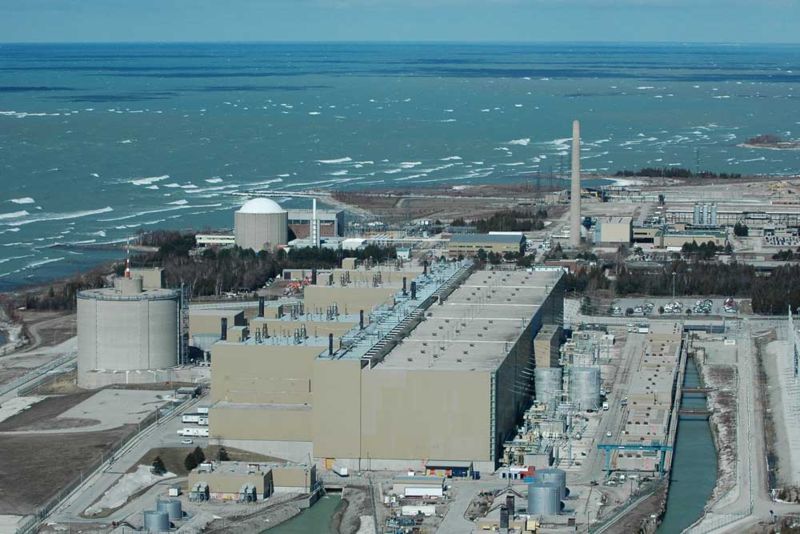
Bruce Nuclear, Ontario, Canada, on Lake Huron.
The site of the proposed deep geological repository of nuclear waste.
Already testing is being done to see if the cold lower layers of water in Lake Huron will contain a nuclear waste spill and radiation, or if any chemical can be dumped into the lake to contain a spill.
Students are being used to do some of the research.
Is it ethical to use students to work on a potentially environmental holocaust project?
Is it ethical to pursue such a project when there is such a great risk involved?
This is insanity to think of building 4 more reactors on Lake Huron and putting radioactive waste for 20 Ontario plants deep underground, less than a mile from the shores of one of the Great Lakes - out of mind, out of sight - and eventually out of reach to stop/retrieve leaks that certainly will attend this dump over time. It also could put these potentially deadly wastes out of reach for retrieval and repackaging, if radioactivity increases dangerously, which could happen in either an accident or incident.
This proposed dump is essentially a plan that would permanently contaminate one of our most precious resources, the Great Lakes Basin. (90 % of the U.S. fresh water, one fifth of the World's). It may also well be the stepping stone to irradiated fuel going into this dump, and although Ontario Power Generation denies that, there are indications that could indeed happen. Even minus irradiated fuel, this dump would eventually contaminate the Great Lakes Basin, perhaps slowly or more quickly, depending on circumstances. And as we all know, we are all connected. Water moves downstream and eventually throughout the globe. Wind currents move faster and globally as well. Evaporation and rainfall connect the wind and water. Slowly but surely, these wastes will outlive their containers. Repackaging underground will be tremendously expensive, dangerous to workers - and even if robots are used, may prove impossible. All of us have witnessed the many serious radioactive plumes leaking from DOE and NRC facilities, many of which have yet to be retrieved for storage. It defies reason to think that this dump will be different.
For 20-40 (60 -80????) years of electricity, those who promote nuclear power have bargained all future generations. They have bargained the future generations' gene pool, their time, their money, their health.- For it is the future generations who will have to guard these toxic and lethal wastes, forever. They will have to never cease watching these wastes for leaks - and repackage them when they leak - an extremely costly, perilous (if possible) job. Since nuclear plants worldwide release radionuclides to the air and water on a routine basis, and many of those radionuclides bio accumulate and many bio concentrate in the food chain, the proponents of nuclear power have also ensured that the health of future generations (plants, wildlife and humans) is compromised.
Interested Parties:
Panel Orientation Session and Comment Period on Environmental Impact Statement and Licence Application for Deep Geologic Repository Project
On February 3, 2012, the Joint Review Panel for the Deep Geologic Repository Project for Low and Intermediate Level Radioactive Waste (DGR) announced the start of the maximum six-month public comment period on the adequacy of the Environmental Impact Statement (EIS) and documents in support of the application for a Licence to Prepare Site and Construct, submitted by Ontario Power Generation. The Panel also announced that it has scheduled an initial Panel orientation session for the review to be held on February 21, 2012 in Ottawa.
Public Comment Period
Preliminary instructions for participation in the public review and comment period are now available. The comment period is an opportunity for everyone to provide their views to the Panel on whether the EIS and licence application documents adequately address the requirements set out in the EIS Guidelines issued to the proponent by the federal government. The public is also invited to make recommendations to the Panel on additional information that should be provided by the proponent.
The EIS and licence application documents are intended to examine the potential environmental effects of all phases of the project and address all requirements for the Licence to Prepare Site and Construct the DGR. The documents are available on the Canadian Environmental Assessment Registry at www.ceaa.gc.ca , reference number 06-05-17520 and through the Canadian Nuclear Safety Commission Web site at www.nuclearsafety.gc.ca.
Please forward submissions in either official language to the Joint Review Panel by mail, email or fax to the attention of either or both Panel Co-Managers on or before August 3, 2012. Documents submitted or generated as part of the review will be posted on the online Registry for this project.
Debra Myles, Panel Co-Manager
c/o Canadian Environmental Assessment Agency
160 Elgin Street, 22nd Floor
Ottawa ON K1A 0H3
Tel.: 613-957-0626 or 1-866-582-1884
Email: DGR.Review@ceaa-acee.gc.ca
Kelly McGee, Panel Co-Manager
c/o Canadian Nuclear Safety Commission
PO Box 1046, Station B –
280 Slater Street, Ottawa ON K1P 5S9
Tel.: 613-947-3710 Fax: 613-995-5086
Email: OPG-DRG@cnsc-ccsn.gc.ca
To be kept informed of the panel review process and ongoing activities, send an email to
DGR.Review@ceaa-acee.gc.ca to be added to the interested parties distribution list.
Panel Orientation Session
The Joint Review Panel invites the public to attend or observe an initial Panel orientation session where information will be provided to the Panel as it begins its work. Although the public will not have an opportunity to ask questions during the session, follow-up questions may be sent to the Panel for its consideration.
The Panel orientation session will be held in Ottawa and webcast live via the Canadian Nuclear Safety Commission Web site at www.nuclearsafety.gc.ca . Transcripts of the proceedings will be posted on the online Registry.
The Joint Review Panel has directed Ontario Power Generation to make a presentation at the orientation session focussed on the organization of the environmental impact statement and licence application documents submission. The Canadian Nuclear Safety Commission will make a presentation regarding its mandate and responsibilities with respect to the project. The expert federal authorities, Environment Canada, Fisheries and Oceans Canada, Health Canada and Natural Resources Canada, will address their departmental mandates and areas of expertise in relation to the project.
The Panel orientation session will be held:
Date
Tuesday February 21, 2012
Location
Canadian Nuclear Safety Commission Public Hearing Room
14th Floor, 280 Slater Street, Ottawa, Ontario
Time
9:00 a.m.
About the Project
The DGR is a proposal by Ontario Power Generation to prepare a site, and construct and operate a facility for the long-term management of low and intermediate level radioactive waste at the Bruce Nuclear site, within the Municipality of Kincardine, Ontario. Low level radioactive waste consists of industrial items that have become contaminated during routine clean up and maintenance activities at nuclear generating stations. Intermediate level radioactive waste consists primarily of used nuclear reactor components, ion-exchange resins, and filters used to purify reactor systems. Used nuclear fuel will not be stored or managed in the DGR.
Canadian Environmental Assessment Agency
Deep Geologic Repository Project
160 Elgin St., 22nd Floor
Ottawa ON K1A 0H3
Tel.: 1-866-582-1884
Fax: 613-957-0941
Email: DGR.Review@ceaa-acee.gc.ca
Parties intéressées :
Séance d’orientation de la Commission et Période de commentaires sur l’étude d’impact environnemental et la demande de permis pour le projet de stockage de déchets radioactifs dans des formations géologiques profondes
Le 3 février 2012, la Commission d’examen conjoint pour le projet de stockage de déchets radioactifs à faible et moyenne activité dans des formations géologiques profondes a annoncé le début de la période maximale de six mois réservée à la présentation d’observations du public sur la pertinence de l’étude d’impact environnemental (EIE) et des documents fournis à l’appui d’une demande de permis pour la préparation du site et la construction d’un dépôt, présentés par Ontario Power Generation. La Commission a également annoncé qu’elle a prévu une première séance d’orientation pour la commission qui se tiendra à Ottawa le 21 février 2012.
Période de présentation des observations du public
Les directives préliminaires pour la participation à l’examen du public et à la période de présentation des observations sont désormais disponibles. La Commission invite toutes les parties concernées à lui dire si elles sont d’avis que l’EIE et les documents fournis à l’appui de la demande de permis répondent adéquatement aux exigences énoncées dans les Lignes directrices relatives à l’EIE que le gouvernement fédéral a remis au promoteur. Le public est également invité à présenter des recommandations à la Commission d’examen sur d’autres informations qui devraient être présentées par le promoteur.
L’EIE et les documents fournis à l’appui de la demande de permis ont pour but d’examiner les effets environnementaux potentiels de toutes les phases du projet et de répondre à toutes les exigences pour le permis de préparation du site et de construction du dépôt. Ces documents figurent sur le site Web du Registre canadien d’évaluation environnementale à www.ceaa.gc.ca, référence # 06-05-17520 et sur le site Web de la Commission canadienne de sûreté nucléaire (CCSN) à www.suretenucleaire.gc.ca .
Veuillez faire parvenir à la Commission d’examen conjoint par la poste, par courrier ou par télécopieur vos mémoires dans l’une ou l’autre des deux langues officielles à l’attention d’un ou des deux cogestionnaires de la Commission au plus tard le 3 août 2012. Les documents présentés ou produits dans le cadre de l’examen seront affichés sur le Registre en ligne pour ce projet.
Debra Myles, cogestionnaire de la Commission d’examen conjoint
a/s de l’Agence canadienne d’évaluation environnementale
160, rue Elgin, 22e étage
Ottawa (Ontario) K1A 0H3
Tél. : 613-957-0626 ou 1‑866‑582‑1884
Courriel : DGR.Review@ceaa-acee.gc.ca
Kelly McGee, cogestionnaire de la Commission d’examen conjoint
a/s de la Commission canadienne de sûreté nucléaire
C.P. 1046, Station B – 280, rue Slater
Ottawa (Ontario) K1P 5S9
Tél. : 613-947-3710 / Téléc. : 613-995-5086
Courriel : OPG-DRG@cnsc-ccsn.gc.ca
Si vous souhaitez être informé du processus de la Commission d’examen et aux activités en cours, faites parvenir un courriel à DGR.Review@ceaa-acee.gc.ca afin que votre nom soit ajouté à la liste de distribution des parties concernées.
Séance d’orientation de la Commission
La Commission d’examen conjoint invite le public à participer ou à observer une première séance d’orientation de la Commission, au cours de laquelle des informations lui seront remises alors qu’elle amorce ses travaux. Le public ne pourra pas poser de questions durant la séance, mais il pourra cependant envoyer des questions de suivi à la Commission qui pourra les examiner.
La séance d’orientation de la Commission aura lieu à Ottawa et une webémission sera diffusée via le site Web de la CCSN à www.suretenucleaire.gc.ca . Les transcriptions des actes de la séance seront affichées sur le Registre en ligne.
La Commission d’examen conjoint a demandé à Ontario Power Generation de faire une présentation à la séance d’orientation sur l’organisation de l’étude d’impact environnemental et sur la présentation des documents à l’appui de la demande de permis. La Commission canadienne de sûreté nucléaire fera une présentation sur son mandat et sur ses responsabilités à l’égard du projet. Les autorités fédérales expertes, Environnement Canada, Pêches et Océans Canada, Santé Canada et Ressources naturelles Canada présenteront leurs mandats ministériels et leurs domaines d’expertise en rapport avec le projet.
La séance d’orientation de la Commission d’examen conjoint se tiendra :
Date
Mardi 21 février 2012
Lieu
Salle d’audience de la Commission canadienne de sûreté nucléaire
280, rue Slater Street, 14e étage, Ottawa (Ontario)
Time
9 h
Au sujet du projet
Le projet de stockage dans des formations géologique profondes est une proposition d’Ontario Power Generation qui vise à préparer un site et à construire et à exploiter une installation pour la gestion à long terme de déchets radioactifs à faible et moyenne activité dans des couches géologiques profondes au site nucléaire de Bruce, dans la municipalité de Kincardine, Ontario. Les déchets radioactifs à faible activité comprennent des éléments industriels qui ont été contaminés pendant le nettoyage et l’entretien aux centrales nucléaires. Les déchets radioactifs à moyenne activité se composent principalement de composantes de réacteurs nucléaires usagées, de résines échangeuses d’ions, ainsi que de filtres usagés pour purifier les filières nucléaires. Le combustible nucléaire usé ne sera pas stocké ou géré dans les formations géologiques profondes.
Agence canadienne d'évaluation environnementale
le projet de stockage des déchets radioactifs dans des formations géologiques profondes
160, rue Elgin, 22e étage
Ottawa (Ontario) K1A 0H3
Tél. : 1-866-582-1884 ou 613-957-0301
Téléc. : 613-957-0941
Courriel : DGR.Review@ceaa-acee.gc.ca
A Press Release on the DGR from Beyond Nuclear.
“Beyond Nuclear joins with a growing groundswell of environmental and public interest groups, concerned residents, and governmental bodies across the Great Lakes Basin, in both the U.S. and Canada, to continue decrying the proposal by Ontario Power Generation (OPG) to bury radioactive wastes on the Lake Huron shore, at its Bruce Nuclear Generating Station in Kincardine, Ontario.
The Great Lakes is the drinking water supply for 40 million people in eight U.S. states, two Canadian provinces, and a large number of Native American First Nations. The Great Lakes, 20% of the world’s surface fresh water, and close to 90% of North America’s, is the lifeblood of one of the world’s largest regional economies. As shown by the Chernobyl and Fukushima nuclear catastrophes, OPG’s proposed radioactive waste dump would put the Great Lakes, and its residents, at risk of radioactive ruination forevermore. This is entirely unacceptable on its face.
As unsafe as a dump on the Great Lakes shore for so-called “low” and “intermediate” level radioactive wastes from 20 reactors across Ontario already is, we fear a bait and switch. Opponents have already had to force OPG to reveal its secretive plans to double the dump’s already monstrous capacity, to take decommissioning wastes after reactor shutdowns across Ontario.
We also fear the remaining proposals in the Bruce area for Canada’s national high-level radioactive waste dump. How much sense would it make to build two deep geologic repositories (DGRs), for different purposes, in the same vicinity? Although OPG optimistically claims its first DGR would only cost some billions to construct and operate, the U.S. Department of Energy’s (DOE) most recent estimate for the price tag at the since-cancelled Yucca Mountain, Nevada DGR was close to $100 billion. And the 2014 explosion of a single barrel, and consequent radioactivity release underground and to the surface environment, at DOE’s Waste Isolation Pilot Plant (WIPP) in New Mexico – which OPG modeled its DGR after – will cost many hundreds of millions of dollars, and perhaps even a billion dollars, to address.
OPG’s insane proposal is a declaration of war against the Great Lakes. If the Canadian federal government decides to support and approve this incredibly risky scheme, our bi-national grassroots coalition will intensify its resistance, as it has done for well over a decade. We commend the 154 municipalities, across all eight U.S. Great Lakes states, as well as Ontario, which have passed resolutions opposing OPG’s ill-advised Great Lakes radioactive waste dump. And we urge all Americans to contact their U.S. Senators and U.S. Representative, to urge their support for bipartisan resolutions in the U.S. Congress expressing strong opposition to OPG’s DGR, and calling upon President Obama to take action against it.”
Panel Orientation Session
The Joint Review Panel invites the public to attend or observe an initial Panel orientation session where information will be provided to the Panel as it begins its work. Although the public will not have an opportunity to ask questions during the session, follow-up questions may be sent to the Panel for its consideration.
The Panel orientation session will be held in Ottawa and webcast live via the Canadian Nuclear Safety Commission Web site at www.nuclearsafety.gc.ca . Transcripts of the proceedings will be posted on the online Registry.
The Joint Review Panel has directed Ontario Power Generation to make a presentation at the orientation session focussed on the organization of the environmental impact statement and licence application documents submission. The Canadian Nuclear Safety Commission will make a presentation regarding its mandate and responsibilities with respect to the project. The expert federal authorities, Environment Canada, Fisheries and Oceans Canada, Health Canada and Natural Resources Canada, will address their departmental mandates and areas of expertise in relation to the project.
The Panel orientation session will be held:
Date
Tuesday February 21, 2012
Location
Canadian Nuclear Safety Commission Public Hearing Room
14th Floor, 280 Slater Street, Ottawa, Ontario
Time
9:00 a.m.
About the Project
The DGR is a proposal by Ontario Power Generation to prepare a site, and construct and operate a facility for the long-term management of low and intermediate level radioactive waste at the Bruce Nuclear site, within the Municipality of Kincardine, Ontario. Low level radioactive waste consists of industrial items that have become contaminated during routine clean up and maintenance activities at nuclear generating stations. Intermediate level radioactive waste consists primarily of used nuclear reactor components, ion-exchange resins, and filters used to purify reactor systems. Used nuclear fuel will not be stored or managed in the DGR.
TIME IS RUNNING OUT ON THE PUBLIC COMMENT PERIOD...SEE POST >>CLICK HERE
Note: The draft environmental impact statement and supporting studies can be found at:
Comments and public records to date can be found at:
Interested citizens can send questions & comments about the project in writing, addressed to:
Dr. Stella Swanson, Chair, Joint Panel Review, at: DGR.Review@ceaa-acee.gc.ca
UPDATE
Sept-Oct 2013 HEARINGS
The Public has come out in force to oppose the
plans for a radioactive waste burial.
Here is a link to Beyond Nuclear's post of the comments so far. COMMENT PAGE
The EIS has been released. You can download it from the link below:
